My Brief Love Affair with Basketball
It's Memorial Day weekend in 2026 and we are deep into the NBA playoffs, so what better time to talk about basketball? Basketball is a sport that I really enjoy playing, and I almost never enjoy spectating. Though I haven't regularly done either of those things in decades. And in my whole life, I never cared more about basketball than I did in the early '90s.
At that time, I was playing basketball constantly. We would have gym class at school where we could play any sport, and we played basketball. You would come home from school. We had three basketball hoops on our street, and I would always play basketball with the neighbor kids almost every day. If you went to a family friend's house for a barbecue, basketball was happening at some point for at least a little bit. On Saturdays in the morning I was in a recreational organized league run by the YMCA, and I played a game of basketball once a week. And then in summer camp, I went to a summer camp at the local school where you would have two chosen activities divided by lunch. Of course, my afternoon activity was computers, but my morning activity was gym. And yeah, we played basketball. We didn't do any of the other gym activities
I was taller than most of the other kids my age. But I stopped growing before I got to the NBA height. I also wasn't very good at basketball. And yeah, you need a lot of advanced skills to win at basketball, but you only need basic skills like dribbling and shooting in order for basketball to become fun. And I had those skills, and I still have the most basic skills now. Though, you don't want me on your team.
Professional Basketball in the Early ’90s
So at that time, not only was I playing a lot of basketball, but professional basketball was having a moment. In June of 1991. Michael Jordan's Chicago Bulls won their first of six championships. Now we sort of take it for granted that there was this legendary dynasty, but this was the beginning. We didn't know what it was going to be. It was absolutely a huge deal.
I'm not a Chicago Bulls fan now, but I was then. I had a Chicago Bulls hat I wore almost all the time. I remember I had a school assignment to write a report on a biography. The biography I chose was a children's biography of Michael Jordan. The Bulls were probably, I think, the only sports team I've ever been a fan of that's not from New York State.
Because the Knicks, I've never been a Knicks fan much. I'm probably paying the price for that now. They're doing so well. But, you know, I was already a Mets fan. I was already a Rangers fan. I didn't feel the need to double down on misery and become a Knicks fan. Even then, as much as that was the biggest basketball time in my life, I didn't enjoy watching it even even then very much.
So not only was the Bulls dynasty beginning, Shaquille O'Neal was in college, and the following year, in 1992, he would be drafted first overall. And I think people remember Shaq now for his NBA career. For good reason. But you don't have to go back and watch his high school and college highlights. Whatever you're imagining, that's what happened. And that was happening at the same time.
Also at this time in 1992, the Summer Olympics were going to take place in Barcelona, Spain, and it would be the first Olympics where professional NBA players would be allowed to participate. And in September of 1991, they announced the first ten players to make the roster of team USA the first Dream Team. The real Dream Team. The most ludicrous, cheat code, overpowered, unfair roster of talent assembled probably in any team sport in the history of humanity, and maybe into the future. It was unbelievable. People don't realize the magnitude of it. I guess if you if you weren't around then. But yeah, we clearly did not appreciate what a privilege it was to live through and witness that era of basketball.
SkyBox’s Competition
While this is all going on, I'm still young and foolish enough to be spending my money collecting sports cards. And of course, I wanted some basketball cards. Nowadays we take for granted that every single sports league, even some minor leagues, have at least one set of professionally produced collectible cards printed once a season. This was not the case in the 1980s.
In the early '80s, Topps, the number one sports card brand stopped making NBA basketball cards entirely. And for a few years the only option was this weird brand called Star, and they didn't print and distribute cards in the normal way. I only know they exist because I looked it up. I've never seen them in my life. Not until 1986. Fleer came in and got the NBA license, and they were the only ones making normal sets of basketball cards until 1989, when NBA hoops came into existence. Then finally in 1990, Upper Deck, we had real basketball sets again. Let's look at some of the cards that I happen to own from that era.
Fleer 1990
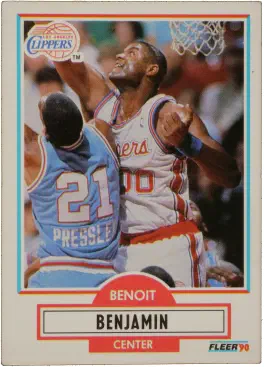
The oldest basketball cards that I own are from Fleer’s 1990 set. And somehow I only have two cards. Benoit Benjamin of the Clippers and Dana Barros of the Seattle SuperSonics. I must have traded for these. I definitely never bought a pack of these, so I don't know. The photography on these is actually pretty good. They went for a lower contrast look than most other cards I've seen from this era, and both of these photos you notice, have a shallow depth of field. So the player is in focus and the background is not. And that's I think it's actually pretty good photography compared to most I've seen.
Everything else about these cards is not great. The graphic design, you could say they were going for a retro look because it kind of looks like a 70s design, but it doesn't come off as retro. This comes off as dated. These don't look great and the backs in particular are terrible. They have this black and yellow thing going on. You can barely make out some of these numbers with white on yellow contrast. The font size is minuscule and all this empty space because Dana Barros only had one year in his career. You can see here Benoit Benjamin had a few more years, but still has a bunch of empty space. These are not good. And I think I would assume it was as a result of Fleer not having much in the way of competition.
Fleer 1991
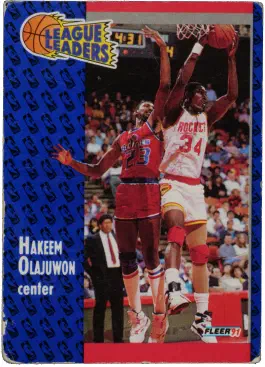
Somehow. I have exactly three cards from Fleer’s 1991 set. Now compared to the 1990s set. These are, I think overall better, but still not great. The photographs are fine, though they've gotten away from the low contrast look. The graphic design is much less dated, but they got this weird choice of the giant blue bar on the side wasting lots of space. I don't know what's up with that. I don't prefer it.
And the backs are really not good because they are not glossy like the front, and they attempted to put player headshots in photos on the back with the non glossy printing, and it really looks terrible.
I also want to point out what I think is a major mistake that happens in sports cards from time to time, and you can see it on this Hakeem Olajuwon card. It's okay when a card is mainly featuring one player to use a photo that contains one or more players other than the stated player. As you can see here, there is Olajuwon and somebody else I don't know. I'm sorry, but if you didn't know who Hakeem Olajuwon was, I mean, you should know a legendary player, but if you didn't know, you could not tell from this card immediately which of these two players is Hakeem.
It doesn't even say Houston Rockets on this card because it's a special league leaders stat card. It's not Hakeem’s main card. Even if you look at the back of the card, the text doesn't give you many hints to figure out which player it is. So when you have multiple players on a card, and that card is supposed to be a card for one particular player, all of the other players should in some way in the photograph, maybe be facing away from the camera or be in the shadows or in the background. Here, both players sort of have equal prominence in the photograph, even though it's supposed to be Hakeem Olajuwon's card. That's bad sports card making.
NBA Hoops 1991
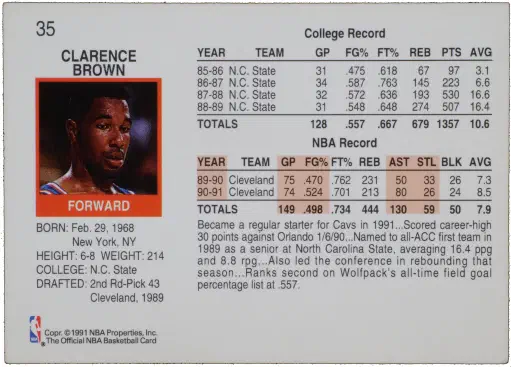
All right, so let's take a look at the first basketball cards I ever bought with my own money. And those are NBA Hoops 1991. It looks like I bought a couple packs of these, which I still have. The graphic design on these is better than Fleer, but that doesn't make it good. This is five minute lazy, no skill, no creative thought, graphic design.
All they did was take the photo. White border, player name, player position, team logo, NBA hoops logo, and then a border color matching the team, and they called it a day. This was lazybones graphic design. Not good. Not inspiring. Doesn't make you want to go get more. This would be good for a website in the era of minimalism, but not good for a sports card.
The photographs are okay, but the printing on some of these cards has sort of a color tint to the photo. I can't tell for sure, but I think what happened is that some of the borders, with a green border here, there might be a little bit of a green tint to the photo. And the orange border here on Chucky Brown's card has sort of an orange tint to the photo. The John Paxson card with the red border seems okay, but the background is mostly black, so maybe that's helping. I don't know, something is wrong with the printing of the photos on these cards. It's not good.
Now the back of the cards is also a mess. So yes, the back of the card is glossy, which allowed them to print a headshot that looks a lot better than the headshots on the Fleer cards. But everything else about the back here is a boring bureaucratic dossier of crunched up text, poor spacing, and this is just awful. Are you looking at a criminal file or a sports card? This is not good. I didn't buy any more of these.
Impel and the Birth of SkyBox
So the basketball card situation was pretty dire. This all changed thanks to a very short lived company named Impel. Impel made various collectible cards. Most notably, they made some Marvel superhero cards that we will be talking about a lot in a future episode. Impel saw that basketball was rising in popularity and that the competition was weak, so they got the license themselves and released their own set of basketball cards.
The problem was that they were a new brand with no name recognition or street cred. Brands matter a lot with collectible cards. You want to collect Topps baseball cards. Every other brand seems like a second rate knockoff. Who wants impel basketball cards? The first thing they did that was very smart. Their marketing people got together, probably with some focus groups, and they landed on the name SkyBox. SkyBox sure feels a lot more premium than impel. Good job.
The second thing is even smarter. They printed a set of 11 prototype cards and they sent them around to vendors, to the media. They handed them out at trade shows. People could see these are a lot nicer and a lot fancier and a lot cooler than all the other basketball cards that already exist. I am going to need to put these in my store because people are going to want them. They are going to sell. And this worked. So these prototype cards have the same exact design as the very first set they released in 1990, but they have this big red prototype label on the corner. You can get these really cheap on eBay. They're not super rare, but I don't have any.
Skybox 1990
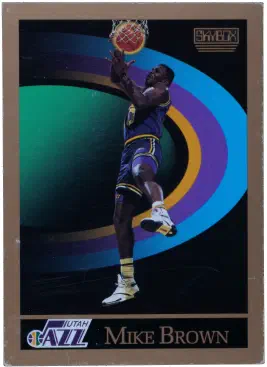
What I do have are exactly four cards. Somehow from that very first SkyBox set in 1990. I don't remember how I got these. I didn't know these cards existed when they came out, and I never bought a pack of them. I must have traded for them or something. This seems to be happening a lot with the basketball cards, but here they are.
For the purposes of this video, I did do something else. I went out and purchased with my own money, a sealed pack of SkyBox 1990 inaugural cards. In this pack there are 15 cards just like these. Now, first of all, I want to point out look how fancy the foil pack is on these. At a time when a lot of collectible cards were still coming in sad wax packs. So even the pack feels premium.
But more importantly, I want to read what is written on the back of the pack, which gives us a keen insight into what Impel was thinking when they produced this set of cards. It says here. Innovative stats. Special NBA scouting computer lets you compare each player with the average of all players at his position. See how a player might do if he played all 48 minutes of every game.
Now on the back of every card you have four rows of stats. It doesn't matter whether the player was in the league for one year, or has a very long career and is about to retire. Everyone has the same four rows of stats. The first row is that players career stats. The second row is that player stats for the most recent season. So you can see is this player doing well now? Maybe they're a great player who's on the end of their career. Maybe it's a player who's rising. Maybe it's a rookie. Both of these lines match each other.
The third row gives you the average stats of all NBA players who play at the same position as the player on the cards. You can say, oh, is this player better than other players at their position? Or maybe they're not as good as other players at their position. And the final row, as advertised, is the per 48 minute stats for the player. You know, some players play a lot. They're in the starting lineup. Maybe they play the whole 48 minutes of the basketball game, and maybe some players are benchwarmers, but maybe they're really good when they come off the bench.
And it can be really hard if you just look at point totals, it's like, hey, yeah, this guy doesn't score a lot of points because they play five minutes a night, but if you let them play the whole game, maybe they don't have the endurance and the stamina. Maybe they wouldn't score that much more. Or maybe, hey, this player is a hidden gem. They should be playing them more. The coach is a fool.
These four lines of stats allow a consistent graphic design across all the cards, and it gives you all the information you need to compare players to each other and to themselves. You don't need to clutter it up with this huge wall of numbers, unless you got freaky stat heads out there, which are not the customers of these cards.
Let us continue reading what it says on the back. Computer charged design utilizing state of the art graphics. Now you can see, right? Unlike any other sports card I've ever seen before these came out, they cut the player out of the background. The real backgrounds of these photos are completely eliminated and masked out and replaced with computer graphics.
Now these aren't that fancy. These look like the backgrounds of your school photos, when you got the lasers and everything back there. But unlike those school photos, each player got their own custom computer graphics, and those graphics are customized to match the action the player is taking. Sometimes the ball is on fire. That's a lot of fun. The colors really provide a good contrast. I like these, I think they're cool, but they could do better. Still really, really new.
Lastly, powerful photographs, action fronts and candid backs selected from the NBA photo archives. Now this is really special. These cards are glossy front and back. And on the back you get a real photo. This photo is fit for a front, but it's on the back. You're getting two photos for the price of one on these sports cards. The photos on the front are all action photos. The player is playing basketball, but on the back they’re candid photos. You're actually getting to recognize the player's face. Maybe see a little bit about what kind of person they are.
Look at this one. Mark Jackson of the New York Knicks. It's just like a professional headshot. It's not even him on the court or anything. These are really terrific. If I had known about these, if I had seen them when they came out, I probably would have collected them. Even though the gold border isn't my favorite, I really have nothing else bad to say about these, but I do love the cards we're going to talk about next a whole lot more.
The SkyBox TV Commercial
Despite watching so much television and seeing so many commercials in the '90s, I don't remember seeing any TV commercials for collectible cards until I saw this one. This commercial for SkyBox basketball 1991. I'm not going to insert the ad into this video, but I'm going to give you tons of links. They'll be in the description in the blog post.
You're going to see the ad. Don't worry. Look how much this ad focuses on computers, megabytes, microchips, digital, the future! This ad was laser targeted at me, specifically. A nerd who collects cards and was into basketball. I wanted those cards very badly, and I couldn't find them. Everywhere I went from the toy stores, to the grocery stores I did not see Skybox cards.
There was no such thing as ordering online. I couldn't get them. If I didn't see them, I couldn't get them. My parents were not the kind of fools who were going to make phone calls and drive all around town to hunt these things down. They were either in the stores we went to when we went to them or they weren't.
What's surprising is that these cards are really easy to get today. They printed them in large quantity. I assume that the distribution was just really uneven, and that some people, probably in big cities, were able to buy plenty of them, and people in areas in the suburbs maybe had a harder time finding them. But if you want them today, you can just get them.
Despite all that, there was exactly one time that I was able to find and purchase some SkyBox. 1991 NBA Basketball Cards. These are the three packs that I bought and have kept since that very day. How I got these packs is a somewhat interesting story in and of itself.
Magic Johnson
It began with another historic moment for basketball from 1991, because on November 7th, Magic Johnson publicly announced that he had HIV and would retire from the NBA immediately. Twenty days later, Freddie Mercury, the singer of the band Queen, died of AIDS. So at that time, I think most people believed, but didn't dare say out loud or explicitly that Magic Johnson would not live very much longer.
So at this point in my life, I was so young that that all I really understood was that on the news every night next to Peter Jennings head was the word AIDS in big capital letters, and it was some kind of disease. If you got it, you could die. So only at this moment when famous people that I had heard of and cared about somewhat were succumbing to this disease, that I start to pay more attention, ask more questions, and truly understand the magnitude of the situation.
Family Outing
So for the majority of my childhood, my family had this routine where we'd go in an outing about once every week or two to eat dinner at a restaurant instead of cooking at home. Nothing fancy because there were some picky eaters in the family. It would always be a diner, Italian, Chinese.
After dinner we would almost always go somewhere else nearby the restaurant, toy store, bookstore, ice cream parlor. Some sort of special treat. And honestly, those were some really terrific memories. I remember those outings with more fondness maybe, than some of the big, expensive vacations we went on. If you have your own family, I recommend developing a similar routine or ritual. And on one such outing shortly after the news about Magic Johnson, we eat at a restaurant in a shopping plaza. In that same plaza or the next plaza over there was a toy store called Toy Works.
The Super Soaker
Toy works itself is a store with an interesting history that's irrelevant, but you can research it if you care about it. This particular Toy Works was a very lucky store for me specifically. Earlier that summer I really wanted a Super Soaker. I needed the Super Soaker. I was getting outgunned. I had useless water weaponry, and most places you could not get it. It was the Tickle Me Elmo. It was the Beanie Baby. It was the Labubu. You could not get a Super Soaker.
But one time we just checked in on the Toy Works. I think we were passing by and I was looking for the Super Soaker 50, the default Super Soaker. The yellow and green one that everyone had. It was the cheaper one, and my expectation was they wouldn't have it and I would go home and, you know, handed.
Just my luck, they did not have the Super Soaker 50. They did have the Super Soaker 100. Now I was disappointed by this because it cost more. I didn't think anyone was going to buy me the Super Soaker 100, but I guess my mom was feeling generous. I got the extra money and thanks to that store, I had the strongest and most powerful water gun in the neighborhood for several years.
The Find
So we go to this Toy Works after dinner, and usually I would be looking at the video games or the LEGO, and I don't remember ever looking for cards there. This time was different because of the SkyBox TV ad, because of the news about Magic Johnson, they were on my mind. And sure enough, this was the one and only time at the front of the store they had SkyBox 1991. I spent the entire dollar amount that I was allowed to spend on these more expensive cards, and got these three packs you see before you. And sure enough, as I was opening the packs in the car on the way home. I don't believe in any superstition or anything like that. You might not believe me, but yes, indeed, the one and only time I bought these packs, Magic Johnson's card was in there.
SkyBox 1991
So what makes these SkyBox 1991 cards so amazing, so special? Before we look at the cards, we have to look at the packs. Yes, I went out and bought some of these as well, only for the second and perhaps final time in my life, more than doubling the size of my collection. And I had to buy so many packs because I wanted to show you that they come in four different styles.
There's no actual difference between these packs, it's just a way to put variety in the box, and maybe stoke the superstition of the buyer into thinking ah yes the blue star always has the Michael Jordan, even though the green Lightning ball is the is the best one, right?
These packs are incredible, and the way that they take advantage of the foil to make them shiny and stand out from all of the other cards on the shelf. The best thing about them is the way the graphics on the outside of the pack evoke the design of the cards on the inside of the pack. So many other sports cards. When you look at the pack, they don't give you any idea whatsoever of what the cards inside actually look like, whereas these do. And that is terrific.
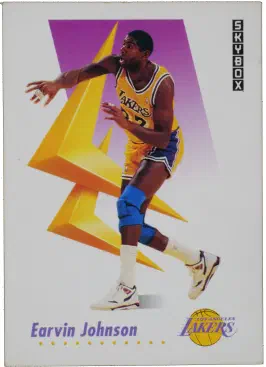
What makes the Skybox 1991 cards themselves so absolutely spectacular? Let's use the Magic Johnson card as a perfect example. They've taken all of the things they've learned from the previous SkyBox 1990 set and improved upon them several fold. Similar to the NBA hoops design. They've gone with the white background and the minimalism, but they have not gone with the lazy graphic design.
A lot of thought was put into this. They're still cutting the player out of the original photo background and adding in the fancy computer graphics, which are much improved a year later. They no longer look flat like they did in the 1990 set. They've also chosen Magic Johnson, who's always played for the Lakers, to put a purple background behind him to contrast with his jersey and these yellow arrows for the Lakers colors.
But the yellow arrows are accentuating the action of him passing the ball. He is known as the greatest or one of the greatest passers in the history of the NBA, and that's what they have him doing on this card. The incorporation of the computer graphics has made this card more of a Magic Johnson card than just the photo alone would have been.
Now remember they talked about the statistics in the 1990s set. They've improved the statistics area significantly. That line that had the stats of players who played the same position, they've removed that because it was redundant, repeating the same information on every single card of every single player who was in the same position. They've also removed the per 48 minute thing, which maybe, you know, you want to see that, but hey, at least they're keeping the consistent graphic design by only having the same exact number of stats visible here no matter how long the player has been in the league.
The first thing you can't help but escape noticing is the player's real first name, what they're known by. Here it finally says Magic. It doesn't say it here. Ken Bannister, his legal name is Ken, but people call him Ken and so on the back of the car. Yeah, it says Ken. Also look at this giraffe photo. Over here Anthony Webb, that's Spud Webb, right? And sure enough on the back Spud looking great with this tux baby.
In addition they've also put lots of other more useful, more fun, information that lets you get to know the player better. What position do they play? How tall are they? What do they weigh? What's their actual birthday? What university did they go to, if any? What year were they drafted? What position in the draft were they drafted? Magic Johnson was drafted first round, first overall in 1979 by the LA Lakers. And because they're only giving you the most recent year of stats for each player, they're telling you how many years the player has been in the league at this point. Magic Johnson had been in the league for 12 years.
Just like the 1990 set they have the action fronts and the candid backs. The candid backs are even more incredible. A lot fewer of the photos are players just on the sidelines. They're actually candid photos taken elsewhere. This one in particular, Magic Johnson, is sitting by the pool, chillin and having a good old time. The front of the card shows you the player that he is, and the back of the card shows you the person that he is.
Skybox 1992
While SkyBox '91 was so difficult for me to find. Skybox '92 was really easy. Look how many I bought. These are the last basketball cards that I ever bought in my youth. I stopped collecting after this. Lost interest in basketball, went on to other things, but I was very lucky in the cards that I did buy. I got Magic Johnson this time not for the Lakers, but playing for team USA on the Dream Team, the gold medal ceremony card.
We got Craig Hodges three point championship card. I distinctly remember watching Craig Hodges win the three point championship right during All-Star Weekend, along with the dunk contest. I was amazed at how many threes he could sink. He would have done amazingly in today's NBA, which is all about the three pointer. I don't think he has anything to complain about he's got two championships
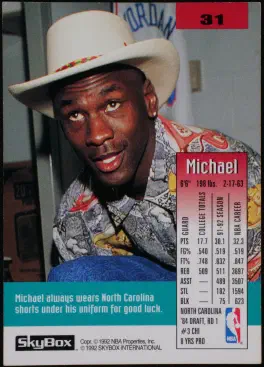
For once, finally we got the Michael Jordan card. The card that I had always been looking for. Maybe that's why I stopped buying because I found the card I wanted and I was finally done. So these cards, obviously they don't have the iconic designs, computer graphics,and fun of the previous Skybox sets. All they've got is this little glowy yellow trail behind the basketball.
These are still nicer than almost all the other basketball cards that have existed up until this point, but is definitely a downgrade from '91. I think they should have just kept that '91 design and just kept using it every single year. Why does every collectible card set feel the need to do a new design every year? It's like, just do find what works and stick with it.
One thing they did do is they kept the candid backs. On the back, here you go, Michael Jordan in a funny hat. They've even improved on it a little bit by including a fun fact. Michael Jordan's fun fact is that he wears his North Carolina shorts underneath for good luck. Everybody knows that. But maybe you're a kid. You didn't know that, and this is where you learned it from.
Let's look at somebody else Anthony Bonner. His fun fact is, Anthony says the person he would most like to meet is Nelson Mandela. Well, Anthony Bonner, I don't know if you're out there. You'll probably never see this. But I hope you got to meet Nelson Mandela. That would have been incredible.
The End of Impel
So, sadly, SkyBox, the design declined and also the brand declined. Remember I told you the Impel Company was making Marvel superhero cards? Well, Marvel, the comic book company liked that so much, they bought the Impel Company entirely. The Skybox basketball cards merged together with the NBA Hoops cards and then sort of disappeared. And that was the end.
While we're unlikely to ever see the SkyBox cards reappear, never say never. Thanks to these cards, I will never forget those few magical years of the early '90s.
Bonus Content
A decade later my friend and podcast co-host Rym had an encounter with Magic Johnson while we were in college. We recorded a brief conversation about this encounter to record the story for posterity.